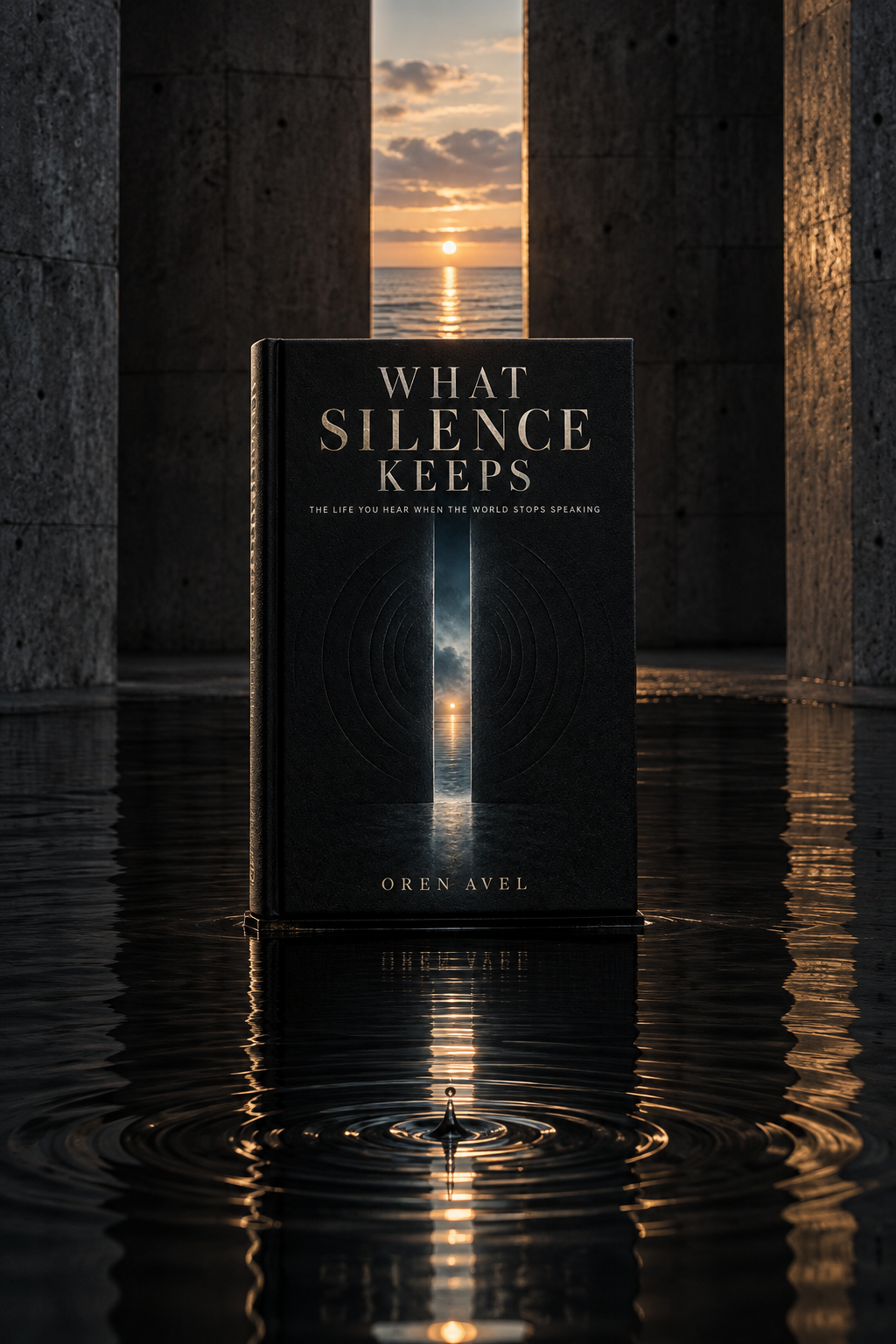
Free sample · Chapter One
The Room We Avoid
from What Silence Keeps by Oren Avel
The first thing many people touch in the morning is not the floor. Before their feet leave the bed, before the curtains are opened, sometimes before they have fully returned from sleep, a hand reaches toward the phone. The movement is so familiar that it barely qualifies as a decision. A screen lights the face in a dark room. There are messages, headlines, numbers beside small red circles, a photograph posted by someone who lives hundreds of miles away, perhaps a piece of news that will produce an emotion before the body has even had water. Within a minute, the mind is no longer where the body is. It has entered other rooms, other problems, other people’s mornings.
This is usually described as a problem of discipline. We are told to move the phone away from the bed, buy an alarm clock, set limits, resist the appetite for stimulation. None of that advice is useless. But it begins too late. It examines the hand reaching for the device without asking what the hand may be rescuing us from.
What was in the room during those few seconds before the screen came alive?
Perhaps nothing dramatic. The weight of another workday. A faint dissatisfaction without a proper name. The memory of something said the night before. The first signs of an anxiety that prefers to arrive before language. Or simply the unoccupied self: no role to perform yet, no one to answer, no event demanding a reaction. For an instant, there is no assignment. Then the phone supplies one.
It would be easy to turn this into an accusation against technology, and easy accusations are attractive because they spare us from looking further. The device is visible; the need it serves is not. A phone can be useful, entertaining, intimate, and occasionally lifesaving. Music can accompany a good life. A series can be enjoyed without becoming an anesthetic. Conversation is not evidence of weakness, and solitude is not automatically virtuous. The question is not whether we use these things. It is whether we are still free not to use them.
That freedom is difficult to measure. A person may put on music while cooking because music gives pleasure, or because the first quiet minute brings back an argument he has been replaying for three days. Someone may watch a video in bed because it is amusing, or because sleep requires passing through a stretch of unguarded thought. A woman may call a friend during every walk because she loves the friendship, or because an empty path leaves too much room for a question about her marriage. The actions look identical from the outside. Their meaning depends on what would happen if they stopped.
We rarely investigate that difference. We defend the activity instead. What is wrong with listening to something? Everyone needs to relax. I work hard. I am allowed to enjoy myself. All true, and not quite an answer. The most effective forms of avoidance are built from things that are reasonable in themselves. If distraction had to look destructive, fewer of us would choose it. More often it arrives as a small comfort repeated until we no longer remember what discomfort it was designed to cover.
Consider the man who falls asleep every night with a video playing beside him. He may not be watching it closely. The subject hardly matters. One night it is a discussion, another night a documentary, another night a stranger explaining a crime committed twenty years ago. The voices continue after his eyes close. If the video ends too soon, he wakes just enough to start another. He would say he needs sound to sleep, and perhaps by now he does. But there may have been an earlier night, long before the habit became ordinary, when silence allowed a particular thought to return. The sound did not solve it. It merely stood guard.
Or consider someone whose schedule is admired by everyone around her. She works, exercises, answers quickly, remembers birthdays, accepts additional responsibility, and is always preparing for what comes next. Her exhaustion appears honorable because much of what she does is useful. When a free afternoon unexpectedly opens, however, she does not feel relief. She becomes uneasy. Within minutes she has found a neglected errand, reorganized a shelf, checked on a colleague’s problem, or made a plan for improving the following week. Motion restores her sense of order. Stillness would expose something less manageable: the possibility that the life she maintains so competently does not feel like hers.
Busyness is difficult to question because the world rewards it. It can earn money, status, trust, and the right to complain about being needed. It gives shape to time and protects us from the embarrassment of not knowing what to do with ourselves. It may also hide despair more successfully than collapse does. A person who cannot get out of bed is recognized as suffering. A person who cannot stop working may be promoted.
This does not make work the enemy. It makes motive worth examining.
There is an important difference between a full life and a life that cannot tolerate an opening. One contains commitments; the other uses commitments as insulation. One chooses activity, then returns from it. The other remains active because returning would mean meeting the person for whom all that activity is supposedly being done.
The distinction becomes visible in small moments. The elevator ride that feels too long without a screen. The red light at which the hand reaches for the phone before the car has fully stopped. The shower accompanied by a podcast, breakfast by a video, exercise by music, work by background noise, dinner by a series. None of these acts is alarming alone. Taken together, they may reveal a life in which consciousness is rarely allowed to arrive unaccompanied.
What are we afraid it might bring with it?
Silence has a poor reputation because people confuse it with emptiness. A quiet room seems to contain nothing, while a screen contains more than we can finish. But silence is not empty in the way an unused box is empty. It is closer to clear water after the sediment has been disturbed. At first, everything that was already there begins to move.
The first things that rise are not always profound. A line from an old conversation. The reminder to buy detergent. A fragment of a song. An imagined response to a comment no one has made. The mind continues producing material because production is what it has practiced. If we remain still a little longer, the content may become less trivial. A mistake returns without the explanation that normally accompanies it. An old humiliation appears with surprising physical force. A decision we have presented as settled asks to be reconsidered. Then the questions begin.
Am I satisfied with my life?
Have I become the person I once intended to be?
Why does this still hurt?
What do I actually want?
These questions are not frightening because they are complicated. They are frightening because an honest answer may interfere with the arrangements we have made. If I admit that I am not satisfied, what does that require of me? If I recognize that I have become someone I would once have distrusted, can I continue blaming circumstance? If something still hurts after years of insisting that it does not matter, what else have I built around that denial? If I discover what I want, what happens to the life organized around wanting something more acceptable?
A question can threaten a structure long before it offers a solution. This is why we often silence it at the first sound. We do not necessarily deny it; denial would require engagement. We postpone it with a task, soften it with entertainment, or bury it beneath the concerns of someone else. The interruption feels harmless. Tomorrow, we think, when there is more time. But tomorrow arrives with its own noise, and the question learns to wait.
Some questions wait for years.
They do not disappear. They change their method of approach. An unanswered question about the direction of a life may return as irritation with people who appear certain of theirs. Unexamined grief may enter relationships as suspicion. A desire we refuse to acknowledge may show itself as contempt for those who pursued it. The mind is inventive when direct admission has been forbidden. What cannot be said plainly finds employment elsewhere.
We then treat the secondary disturbance as the entire problem. We try to become less irritable, less jealous, less restless. We manage the expression while protecting the source. It is like repeatedly wiping water from a floor without looking under the sink. The work is real, the fatigue is real, and the room never becomes dry.
Silence does not repair the leak. It allows us to hear it.
That is already more than many of our habits permit. Yet anyone who has sat alone without external sound knows that removing noise from the room does not create quiet in the mind. Sometimes it does the opposite. The absence of sound reveals an interior so crowded that the room seems louder than before.
There are conversations taking place with people who are not present. In one, we finally say the perfect thing and watch the other person recognize how wrong they were. In another, we anticipate an accusation and prepare a defense against it. We revise a meeting that ended hours ago. We rehearse a meeting that may never happen. We explain ourselves to judges we have assembled from memory: a parent, a former partner, a colleague, an audience whose membership changes but whose verdict remains strangely consistent.
There are futures being manufactured at high speed. What if I lose the job? What if the pain means something serious? What if they stop loving me? What if I make the wrong decision and understand it only after repair is impossible? Each scenario generates another. The mind attempts to purchase safety through prediction, but the price is paid in the present. We suffer events that have not occurred, sometimes repeatedly, as if anxiety could make advance payments on grief.
There are comparisons, too. They rarely compare whole lives. The mind takes another person’s visible advantage and places it beside our private uncertainty. Their relationship is compared with our loneliness, their income with our fear, their confidence in one photograph with the hesitation we feel across an entire week. We call the result evidence. It is closer to a rigged trial in which the prosecution selects material from two different cases.
Regret keeps its own archive. It retrieves a sentence from twelve years ago with perfect clarity while losing all record of the ignorance, pressure, or limitation under which it was spoken. Sometimes regret is necessary; without it, conscience would have no memory. But regret can also become self-punishment disguised as moral seriousness. The mind repeats the scene not to learn from it but to preserve a familiar verdict about who we are. Pain becomes proof, and proof becomes identity.
This is internal noise. It is not measured in decibels. A silent person can be crowded by it from morning until sleep.
External noise enters through the senses: notifications, traffic, voices, entertainment, demands. Internal noise uses memory, imagination, judgment, and anticipation. The two cooperate. Outer stimulation can prevent us from noticing the inner commotion, while inner commotion makes outer stimulation feel necessary. We turn something on because we cannot bear what is happening within; after enough years of turning something on, we lose the ability to recognize what is happening within. The relief is genuine. So is the cost.
It would be unfair to describe all inner noise as self-created. A nervous system shaped by danger does not become calm because someone recommends meditation. A person living under financial threat, caring for a sick parent, facing discrimination, or recovering from violence is not merely failing to manage thoughts. Circumstances enter the body. They teach attention what to scan for and sleep what to fear. Silence can feel unsafe to someone whose vigilance once had a purpose.
Compassion matters here because self-examination without context easily becomes another form of cruelty. We should not shame the mind for learning how to survive. But a method that once protected us can continue operating after its conditions have changed. The locked door remains locked on a safe street. The apology is prepared before anyone is angry. Rest feels dangerous even when no emergency is coming. To understand this is not to condemn the adaptation. It is to ask whether we still wish to live inside it.
The question changes the atmosphere. Instead of saying, Why am I like this? with the impatience of a judge, we might ask, What has this been doing for me? What does it prevent me from feeling, risking, or knowing? A habit viewed only as weakness invites force. A habit understood as protection invites a more intelligent kind of courage.
Perhaps this is why our escapes deserve curiosity before they deserve correction. If a person takes away every distraction without understanding its function, the hidden distress does not vanish. It simply loses its usual container. That can be clarifying, but it can also be overwhelming. There is no virtue in flooding oneself. Silence is not a punishment to be endured, nor a test in which the most spiritually advanced person lasts the longest without moving. It is a relationship, and relationships become honest through attention rather than force.
At first, attention may reveal how little control we have over what appears in the mind. Try not to think for thirty seconds and watch what happens. A thought arrives, then another comments on the first. An emotion follows, perhaps annoyance at being unable to stop. The mind proposes an image, a memory, an item from a list. You notice that you have been carried away and return, only to discover moments later that an imaginary conversation has resumed without permission.
Who noticed?
The question is easy to pass over because grammar makes it seem obvious. I noticed my thoughts. But what exactly does that sentence contain? There were thoughts, and there was an awareness of those thoughts. There was anger, and something knew anger was present. There was fear, then the recognition: I am afraid. The contents changed. The capacity to notice remained.
We usually speak as though thought and thinker were identical. I am a failure. I am unwanted. I am in danger. I am better than them. I will never change. A sentence appears in consciousness, and before it has been examined, it is granted the authority of identity. We do not say, A thought about failure has appeared. We say, I am a failure. The distance between those statements is small in language and enormous in experience.
If a cloud passes through the sky, we do not assume the sky has become a cloud. Yet when fear passes through awareness, we often allow fear to define the whole field. This comparison has limits, as all comparisons do. Thoughts are not weightless weather. They can shape decisions, relationships, bodies, and entire lives. But their consequences do not prove that every thought tells the truth, or that the one who notices a thought must be reducible to it.
So let the question stand without rushing to make it mystical:
If you can observe your thoughts, are you actually your thoughts?
There are quick answers available. Philosophy has some. Psychology has others. Religious and contemplative traditions have been living inside the question for centuries, though they do not all describe the same discovery. Neuroscience can show relationships between mental events and activity in the brain, but even precise measurement does not remove the intimacy of the question as it is experienced from within. We could collect explanations and still use them to avoid looking.
For now, no explanation is required.
Notice instead what happens when a thought is seen as an event rather than an order. Suppose the mind says, They do not respect me. Ordinarily, the body responds before an investigation begins. The jaw tightens, evidence is gathered, neutral behavior is reinterpreted, and a reply starts composing itself. But if the thought is noticed—fully noticed, without being mocked or obeyed—another possibility enters. Perhaps it is true. Perhaps it is partly true. Perhaps it is an old expectation using a new face. The important change is not that the thought has been defeated. It has been placed where it can be examined.
That small space between a thought and allegiance to it may be one of the least dramatic forms of freedom. No one sees it. Nothing has yet changed outside. Still, a chain that normally completes itself has failed to close: perception, story, emotion, reaction. Awareness has entered between story and reaction, and what seemed inevitable becomes available for choice.
This does not mean there is a calm, flawless observer hidden inside us, untouched by history and waiting to manage everything wisely. Even the observer can become another performance. A person can pride himself on being detached while using detachment to avoid tenderness. He can watch his feelings so clinically that he never permits himself to feel them. He can turn awareness into surveillance, monitoring every thought for signs of impurity or failure. The inner witness is not another supervisor to place above the mind.
Perhaps it is better, at this stage, to think of it simply as the fact of noticing. Before we decide what that fact means, we can become acquainted with it. Thoughts change. Moods change. The body moves from energy to fatigue, health to illness, tension to release. Roles change, convictions change, relationships change. The person we describe at twenty is not the person we describe at forty, and yet there is some continuity in the experience of having been present for both. What is that continuity? Memory cannot entirely explain it; memory itself is partial, revised, and sometimes false. Personality cannot entirely explain it; personality changes and is expressed differently in different rooms.
Who, then, is aware of the change?
We are near a territory where language becomes unreliable. The moment we name the observer, we risk turning it into another object, another concept to possess. Words such as consciousness, awareness, soul, and self arrive carrying histories, doctrines, disagreements, and promises. They may become useful later. At the beginning, they can also become curtains. It is possible to debate the name of a place one has never visited.
Better to begin with an ordinary experiment that does not look like one. The next time you sit in a room and feel the reflex to reach for sound, do not immediately forbid the movement. Pause before it. Notice the sequence. Was there boredom first? Unease? A pressure in the chest? Did a particular thought begin to form? Did the hand move before the thought could finish? You may still play the music or answer the message. The purpose is not to win. It is to see.
Seeing changes our relationship with habit. What was automatic becomes visible; what is visible can eventually be understood. Perhaps you discover that you reach for the phone whenever you feel excluded. Perhaps work expands each time grief approaches. Perhaps background noise is simply pleasant most of the time, and on certain nights it protects you from a loneliness you have not admitted. Human motives are rarely pure. We can enjoy something and use it to hide. We can love our work and fear the person who remains when the work is done.
There is no need to dramatize the discovery. The mind may be tempted to convert it into a new identity: I am someone who avoids silence. I have wasted years. I am addicted to distraction. Such declarations can feel honest while closing the very inquiry they appear to begin. A label ends the conversation. Curiosity keeps it open.
And curiosity is what silence requires from us first.
Not courage in its most theatrical form. Not the destruction of our devices, the cancellation of pleasure, or withdrawal from everyone we love. Only the willingness to remain for a few seconds beyond the point at which we usually leave ourselves. In those seconds we may hear nothing important. We may hear mental debris. We may become irritated. But if we return without violence, the mind gradually learns that not every unfilled moment is a threat.
Then quieter distinctions become possible. We begin to recognize the difference between loneliness and the absence of stimulation, between intuition and fear, between a need and an impulse, between the voice of conscience and the echo of someone else’s expectation. These distinctions cannot be downloaded as rules because their texture is personal. They are learned by staying close enough to experience to notice what changes and what repeats.
This is where a different kind of knowledge begins. Most of what we call knowledge adds something: a fact, a method, a theory, a name. Self-knowledge often begins by subtracting interference. It does not always tell us something new. Sometimes it allows us to hear what we have known for years beneath the arguments assembled against it.
You may already know that a relationship has ended in every way except formally. You may know that the career you worked hard to enter requires a version of you that you do not respect. You may know that your anger toward one person belongs partly to another. You may know that the goal occupying your imagination was inherited from a family, a class, a culture, or a younger self who had different needs. The knowledge has not been absent. It has been kept below the level at which it could make a claim.
Noise helps with that arrangement. It does not erase what we know; it keeps the knowledge from completing a sentence.
This may be why certain moments of involuntary quiet affect us so strongly. A power outage after dark. The minutes after guests leave. A drive on an unfamiliar road when the signal disappears. The strange stillness of a home after a death, a separation, or a child has moved away. The outer structure pauses, and something we had managed not to hear becomes suddenly articulate. People sometimes call these moments empty because an expected presence is missing. Yet the emptiness has content. It contains the shape of what mattered, the cost of what was avoided, and the person we were while the noise continued.
We cannot live permanently in such moments, nor should we try. Human life requires participation. There are meals to prepare, promises to keep, jokes to enjoy, people who deserve our full attention, and work that becomes meaningful precisely because it takes us beyond ourselves. The purpose of silence is not to make the world less vivid. It is to keep the world from becoming the only voice authorized to tell us who we are.
Without that counterweight, identity becomes reactive. We feel valuable when noticed, certain when agreed with, attractive when desired, secure when busy, and real when reflected in other people’s responses. When those responses change, the self constructed from them changes too. We then chase stability by trying to control the mirrors. Silence offers no flattering reflection, but it may reveal who has been standing in front of them.
That revelation will not occur once and settle everything. The self is not a riddle with a final line printed upside down at the back of the book. We meet it under changing conditions. A truth visible in grief may disappear in comfort. A strength discovered in solitude may fail in company. We will misunderstand ourselves, correct the misunderstanding, and later discover that the correction was incomplete. This does not make the inquiry futile. It makes humility part of the method.
Perhaps the first humility is admitting that we do not know what our constant noise has been preventing us from hearing.
Maybe there is no devastating secret beneath it. Maybe there is fatigue that needs rest, sadness that needs a name, desire that needs permission to become precise. Maybe there is anger with a legitimate message and an illegitimate target. Maybe there is a life not entirely wrong, only lived at such speed that its meaning has never caught up with it. We cannot know in advance. That is the point.
We often say that we are searching for answers. The phrase makes us sound active and sincere. But answers require conditions in which they can be recognized. A person may stand beside a quiet truth for years while listening for something louder. He may demand certainty when the first available truth is only a discomfort that returns. He may expect direction to arrive as confidence, when it first arrives as the inability to continue pretending.
Perhaps the problem is not that we have no answers. Perhaps it has never been quiet enough to hear them.
If that possibility is even partly true, then silence is not the absence we have treated it as. It is not dead air between useful events. It is not a blank space that responsible people must fill or lonely people must escape. It may be the place where experience stops being immediately converted into reaction, where the mind becomes visible without being granted absolute authority, and where a life can finally be felt from the inside.
The next time a room becomes quiet, notice how quickly you leave it without moving.
Notice where you go.
And before you follow, ask who remained behind.